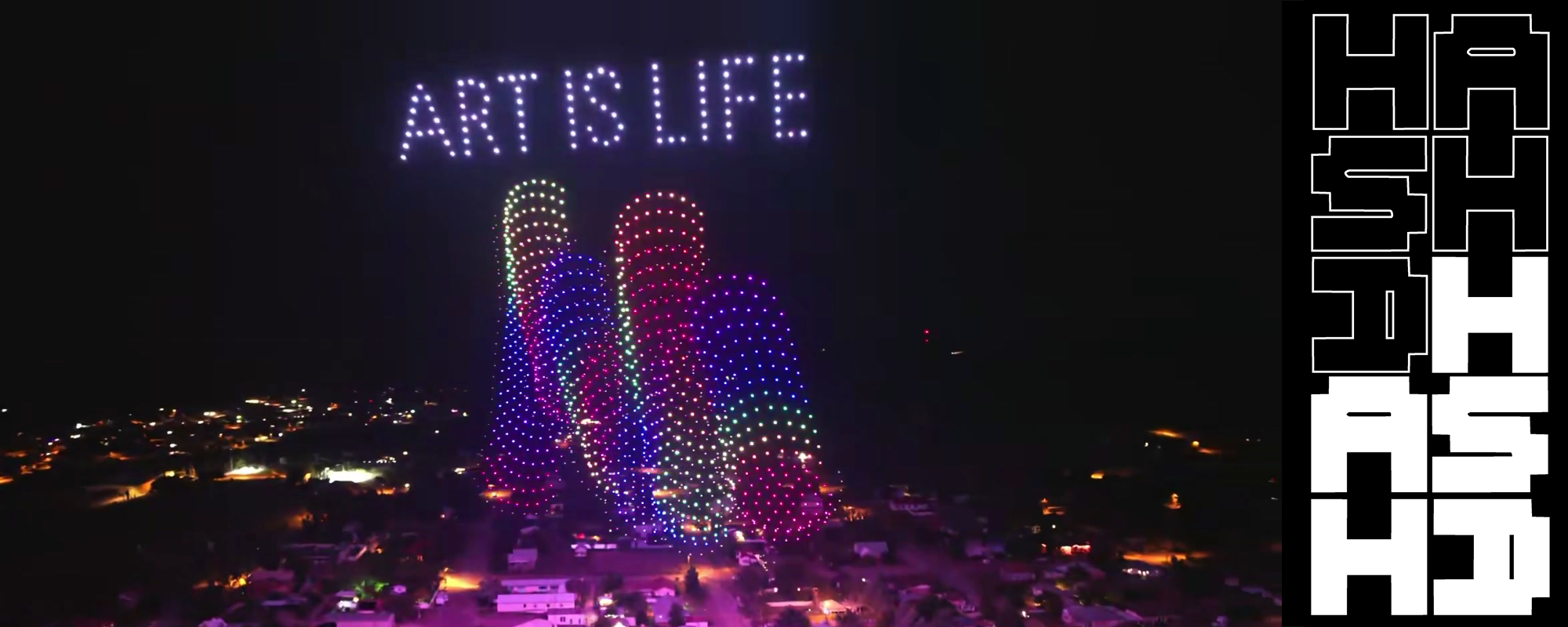
Pixel Pete was standing outside a reading in Marfa when someone pointed towards the sky. Above the town was a giant green lizard, accompanied by the words “THE PALACE IS OPEN.” He felt embarrassed, he writes in “ART IS LIFE”, “as if everyone present might associate me with this.”
That feeling is the beginning of his essay, but it is also the beginning of a question larger than the one he sets out to answer. Pete was watching a culture he had helped build become visible to a public he cared about, in a form he had not chosen. His embarrassment came partly from being made to feel represented.
The drone show was presented by Adam Weitsman as part of a closing party listed on Art Blocks’ official schedule. A sequence of images associated with different projects appeared above Marfa. The Chromie Squiggle closed the show, beneath the words “ART IS LIFE.”
I find that ending difficult. Not because the Squiggle should have been protected from the company it kept, or because a gathering in Marfa should be too solemn for spectacle... The problem is that an image closely associated with Art Blocks and its history was placed at the end of a sequence assembled for a particular celebration, beneath a statement large enough to seem like it spoke for everyone. A private decision had acquired a public voice...
The people who saw it could reasonably understand it as a declaration about what this community is and what it values. Yet the community did not arrive at that declaration together. An event does not need anyone’s unanimous permission to take place, but when it borrows the symbols and standing of a shared culture, it invites a question about whose choices have become visible as ours.
Pete describes what unsettled him as the sense that everything was celebrated equally... I think the deeper problem is that celebration at this scale can make an arrangement of images look like a settled account of their meaning. It turns proximity into a statement and leaves everyone associated with the statement to explain themselves afterwards.
Pete’s essay is generous to the people involved, including himself only after some hesitation. He acknowledges that his own collection contains hundreds of NFTs acquired through speculation, and that his taste often came second to his belief in supporting experimentation. He recognises the artistic inquiry, commerce, friendship and community as things he has participated in, not forces that arrived from elsewhere to spoil the work.
That honesty is important. It also makes it possible to move past the easy argument that speculation and celebration have contaminated an otherwise pure art culture. They have helped create the conditions in which much of this culture exists. Some of the work would look different without them. Some of it would not exist at all.
I have argued before that participation can become part of an artwork’s significance. In At What Point Did CryptoPunks Become Art?, I suggested that ownership, identity, speculation and sustained attention helped form a cultural object larger than the original images. I still believe that meaning can accumulate through these activities.
But participation does not automatically produce a persuasive account of what has been made. A community can create something worth studying and become convinced of its own importance at the same time. The people most able to explain why an object matters may also be the people who have the most invested in its mattering.
We need to be able to live with that tension. Otherwise, “community” becomes an answer to every question about quality, and every objection can be dismissed as evidence that the critic was not there.
I know how attractive a favourable explanation can be when it concerns my own place in a culture.
In Collecting as a Kill Clause, I wrote about being selected to purchase an XCOPY edition. I had written about his work and paid attention to his practice. I wanted to believe that attention might have counted in my selection.
It may have done. I do not know. What I could see was how quickly I began constructing an account in which I had been recognised for something more meaningful than my ability to pay. My interest in the work was real, but so was my desire for that interest to distinguish me from other collectors.
The distinction is revealing here because the stories we tell about our participation do more than describe it. They help us decide what we are entitled to say. A collector becomes a patron. A patron becomes a custodian. A custodian becomes someone who can speak for the culture. Each step may have some justification, but none follows automatically from the one before it.
My writing is part of that process too. When I make a case for a work I own, I am contributing to how it might be understood. I may also benefit if that understanding takes hold. Disclosure makes the relationship visible... it does not resolve the judgment for the reader.
Weitsman’s role is more interesting than a simple account of a wealthy outsider imposing spectacle on an art community. He has collected digital art and supported artists. He commissioned ACK’s Bösendorfer, which was unveiled at the same party. The same patron was involved in both the artwork and the show.
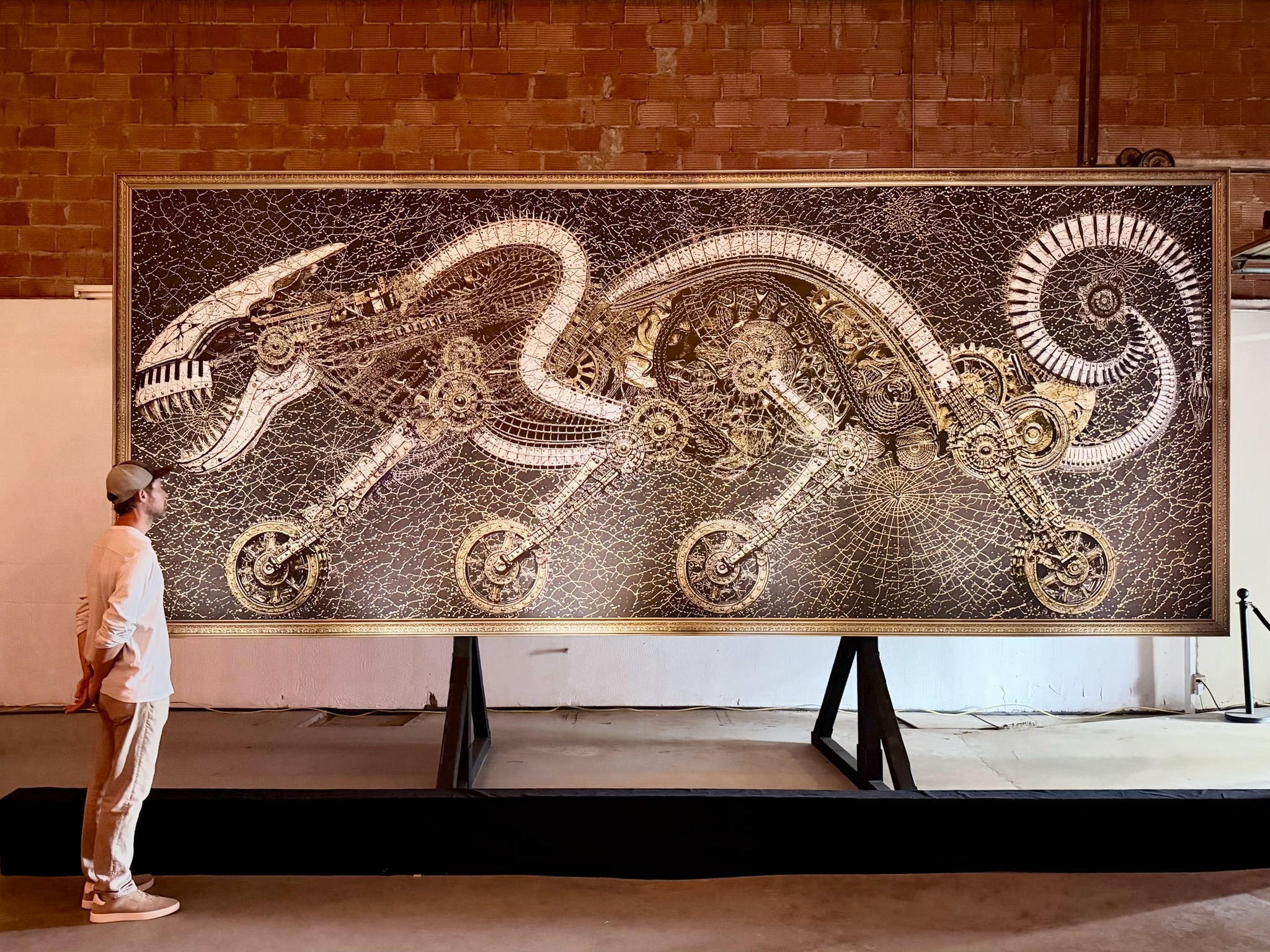
That complicates the criticism, but it does not remove it. A patron’s ability to support serious work does not settle how their public presentation of a culture should be understood. Generosity can be sincere and still carry influence. Scale can make one person’s choices feel like a collective position.
Weitsman called the party his event and spoke publicly about raising the bar for Marfa in 2027. Art Blocks listed the closing party on its schedule, promoted it, and thanked him as a sponsor. Those are different forms of involvement. Together, they gave the event a relationship to the gathering that was visible to anyone looking at it from outside.
The artist whose image appears in the sky may have intended one thing. The patron presenting the event may have intended another. The platform may have understood the party as a welcoming close to a weekend of programming. An attendee may simply have enjoyed seeing something familiar overhead. But the public image that results does not arrive with those distinctions attached.
It arrives as an image of us...
That is why “who speaks for the community?” cannot be answered by saying that everyone speaks. Everyone participates, but not everyone has the same capacity to make their participation visible. A patron can produce an event. A platform can place it on a schedule. An artist can make an image that becomes recognisable enough to stand for something beyond the work itself. A crowd can give that image an atmosphere of shared enthusiasm.
Each contributes something real. The power to combine those contributions into a public statement is distributed unevenly.
This is also where Pete’s appeal to discernment becomes useful. I do not think a party owes us a hierarchy of artistic merit. People should be free to enjoy themselves, and a closing celebration has a different purpose from an exhibition or an essay.
But a culture cannot rely on celebration to explain why its work matters. Enthusiasm shows that people care. It does not tell us what they care about, whether the object rewards attention, or how its claims might stand up outside the group that already knows and loves it.
Those explanations require criticism. They require people willing to look closely at individual works, describe what they do, place them in relation to other things, and risk being wrong in public. They also require a community willing to hear a judgment that does not flatter its holdings, its friendships or its preferred account of itself.
This should apply across the board. A PFP deserves more than dismissal because it looks like a cartoon... its visual language, social life and structure may contain an argument worth examining. A work presented as serious generative art deserves more than reverence because it resembles something a museum might recognise. Both deserve attention specific enough to produce a judgment.
My concern with the show is that its strongest public statement was made through association and scale. The Squiggle appeared at the end, under “ART IS LIFE,” in a format that treated the images as elements of one spectacle. Whatever each project meant to its own participants, the presentation offered little of that history to someone seeing it from the street or through a clip. It made the images legible as a celebration while leaving their differences largely unexplained.
There is pleasure in that. There is also a loss. A culture that wants its work to be understood cannot leave its most visible representations to the format best suited to making everything immediately recognisable.
The question of who gets to speak also extends to people who were not at the party, or could not be. A public street event is more open in one sense than a private room. It still reflects decisions made by a smaller group with the money, relationships and ability to be there.
Digital art often describes itself through global participation. That promise deserves to be taken seriously, including when geography, wealth, mobility and access shape whose presence is possible and whose voice carries. A community may be distributed across the world while the occasions that represent it are concentrated in places only some of its members can reach.
I do not know enough about the response from Marfa residents to speak for them, and I do not want to use the town as a symbol for a disagreement occurring elsewhere. That limit is part of the point. When a culture enters a place, its members may debate what the event means to them while knowing very little about what it means to the people who live there.
Pete’s essay asks whether the thing that has occupied so much of his life belongs within a larger artistic lineage. I think much of it does. I also think that belonging has to be argued for work by work, with enough attention to distinguish artistic achievement from historical importance, financial success, social belonging and promotional reach.
Those categories overlap. A project can be historically significant without being a great work of art. An image can hold a community together without making a compelling claim on someone outside it. A patron can support valuable work and still exercise cultural influence in ways that deserve scrutiny. Making those distinctions is part of taking the culture seriously.
Pete could not choose what appeared above Marfa, but he chose to examine his response to it. The rest of us can do the same with our own participation, and with the public images produced in our name.
“We” can be a useful word. It lets people recognise a shared investment in something they have helped build. But when someone speaks for that “we,” we should be able to ask who assembled the statement, whose work gave it meaning, and who had the power to put it in the sky.