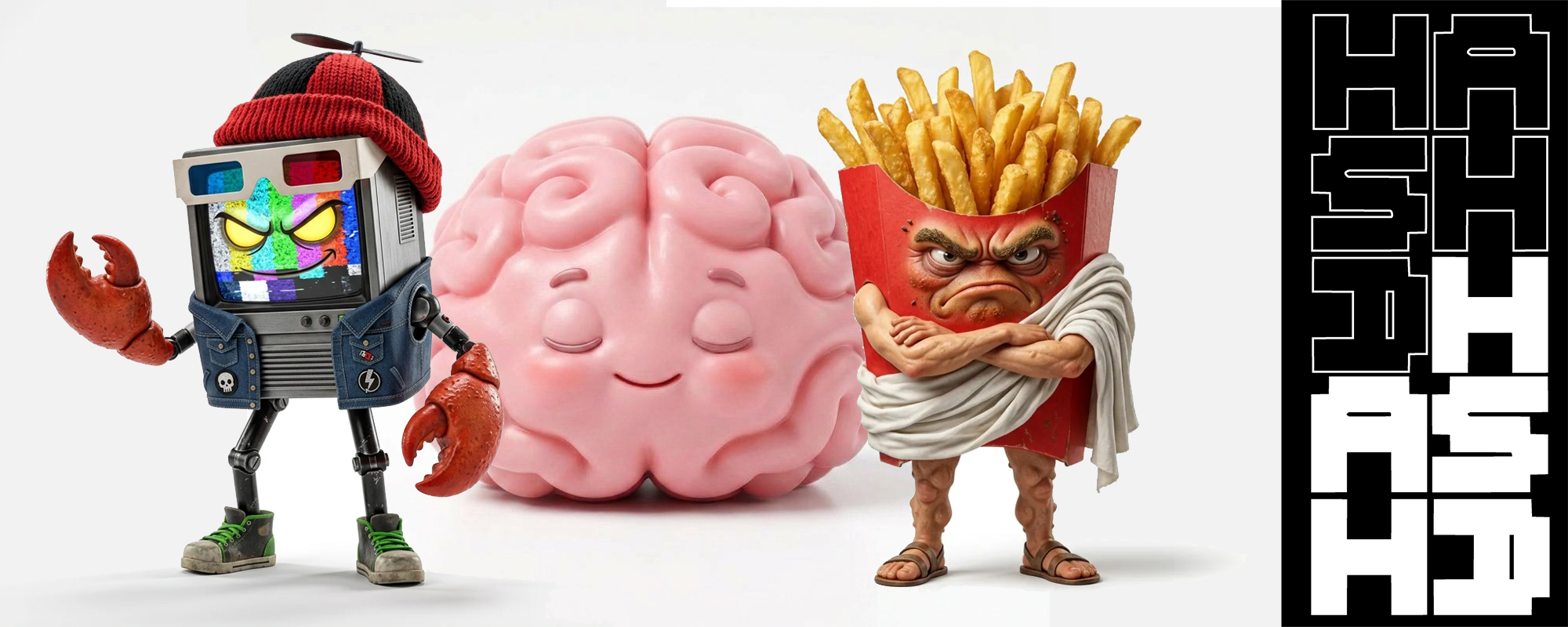
There is a particular kind of image flooding the internet right now: a crocodile fused with a fighter jet, a chimpanzee whose body is a banana, hybrid creatures with Italianized nonsense names and AI-generated voices babbling over them. It is called brainrot, and it is what happens when generative AI is pointed at attention with no hand on the wheel. Most artists would run from it. Nuclear Samurai built a factory to study it.
BRAINROT is his new collection of 10,000 specimens, and the word specimen is doing real work. These are not characters he drew. They are things grown, catalogued, and judged by a machine he designed to behave like the internet that produced the phenomenon in the first place. It is the sharpest expression yet of the identity he keeps in his bio, latent space voyeur, an artist who watches the machine dream and decides which dreams are worth keeping.

A factory, not a brush
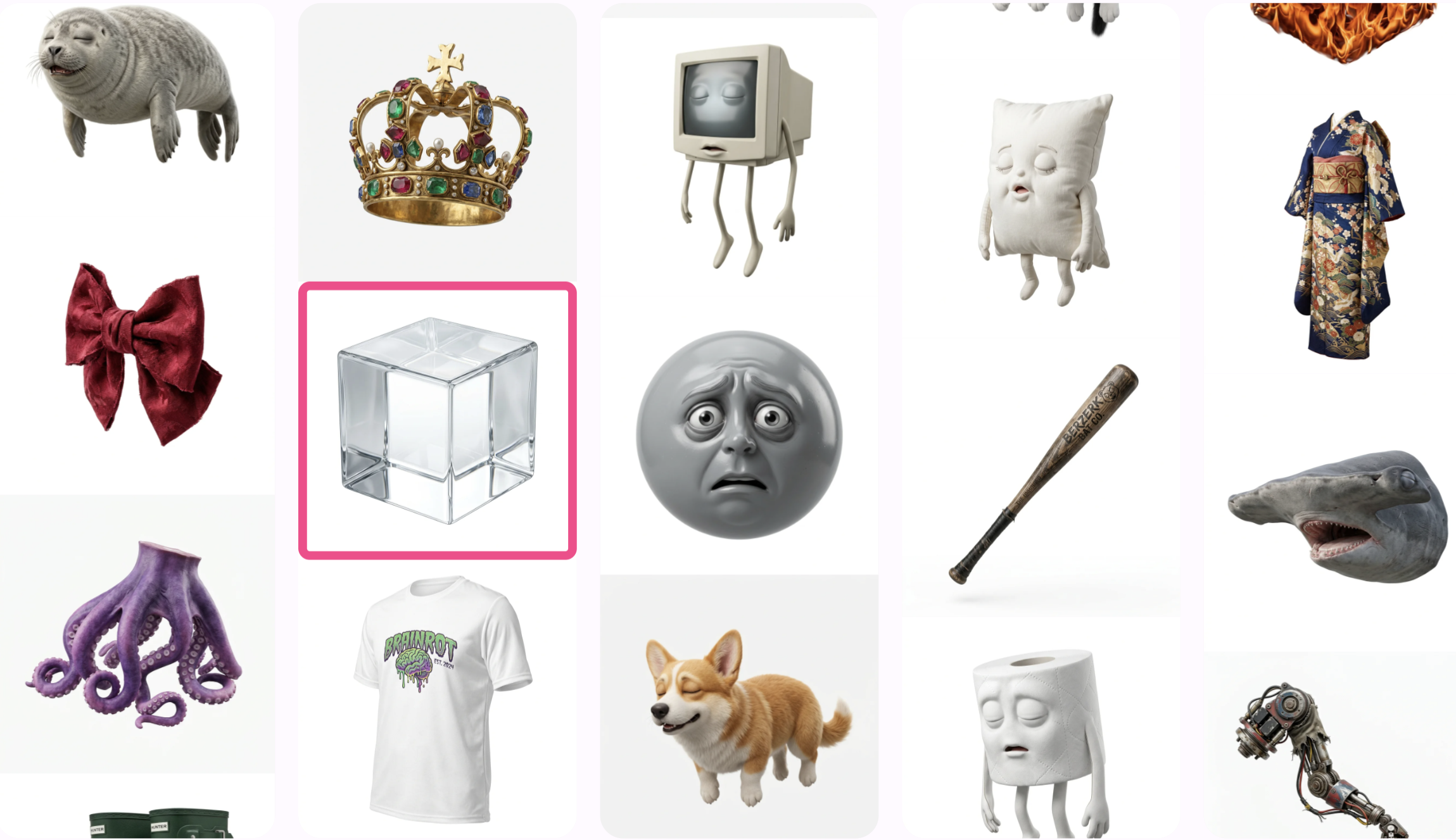
The process is the artwork. BRAINROT began as a research project, a team of AI agents sent to study the trends of brainrot, to crawl the AI slop saturating the internet and learn its patterns. That research fed a combinatorial generator built from 678 components, archetypes, materials, accessories, fashion, elemental traits, assembled according to a small set of rules and interpreted by a renderer into images. The system chose its 10,000 from a possibility space exceeding one billion configurations. As the project frames it: the factory is the artist, and the ten thousand are what it chose to show us.
Then comes the structure that makes it more than a generator. Every specimen is put on trial. An Advocate frames the case in the creature’s favour. An Adversary argues against it. And a Judge writes the verdict: an outcome label, a one-line summary, and a numerical score. The draw is automatic, the specimen pulls its own counsel and judge, and each trial is recorded as permanent metadata. Machines make the creatures. Machines argue about them. Machines score them. The artist’s hand is in the architecture, not in any single drawing.
The collection is fixed at 10,000, never to be added to, but each specimen carries its own trial record, divergences, and post-creation modifications. The creatures are static. The information around them is not.
The court
The court is where BRAINROT turns from clever to genuinely interesting. There are twenty judges, each a distinct AI persona with hard-coded biases, and each specimen is scored against eight quality metrics designed to measure exactly the things that make slop work: Scroll-Stop, Replicability, Quotability, Cursedness, Cuteness, Iconicity, Discourse Fuel, and Lore Density. Every judge rewards two of those qualities and is allergic to others.

The result is a bench that reads like a parody of internet taste itself. A retired federal judge who is generally allergic to everything. A LinkedIn thought leader who rewards replicability and hates obscure lore. A 4chan greentext federalist who rewards cursedness and cannot stomach wholesomeness. A daytime TV judge who loves scroll-stop and quotability but recoils from anything cursed. A Facebook boomer magistrate who rewards cuteness. A law professor who has never tried a case but is enthusiastic about everything. Twenty positions, twenty fixed biases, and the specimen has no say in who hears its case.
It is a system built to be unfair on purpose, because that is how cultural value actually gets decided, online and off. The judges do not pretend to be neutral. They are advocates for specific kinds of attention, and the verdict a specimen receives depends entirely on which judge it draws. Nuke has taken the least serious material on the internet and used it to model one of the most serious processes in it: the manufacturing of taste by people, or machines, who were never objective to begin with.
The throughline
BRAINROT does not arrive from nowhere. It is of a piece with everything Nuclear Samurai makes, work that turns AI on the systems shaping modern life and refuses to look away from the ugly parts. His TOYBOX imagines action figures of people straining to meet impossible standards. His New Gods series builds a pantheon out of landlords, gamblers, and influencers. The throughline is an artist using the machine to diagnose the machine, comfortable in the latent space precisely because he treats it as a place to observe rather than escape.
BRAINROT is that instinct at its most complete. He did not just make art about AI slop. He built the slop a factory, gave it a court, and called the results specimens, as if they were pinned insects in a vitrine, evidence of a moment we are all living through whether we look at it or not.
The internet is rotting our brains in real time. Nuclear Samurai decided to preserve the rot under glass, let twenty biased machines argue over which pieces were worth keeping, and left the rest of us to answer the only question that matters: if the machine makes the art and the machine judges the art, what exactly is the human for?