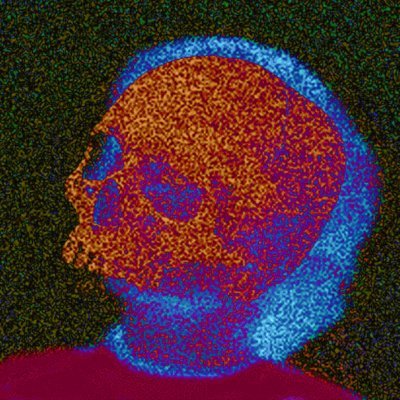
A 363 MB artwork inscribed directly into Ethereum, retrievable from any browser with no website, no marketplace, no external dependencies. ACK on what he built, why this work, and what comes next.

For years, the digital art world has lived with a quiet uncertainty. NFTs point to files. The files live on IPFS, Arweave, or hosted servers. Those services depend on infrastructure, on pinning fees, on companies that may or may not exist in twenty years. The token is permanent. The artwork it points to is not.
Alpha Centauri Kid has been thinking about this problem for a long time. Working with Richerd, with engineering support from yungwknd, and development assistance from Anthropic’s Claude, he built a system that solves it for a single piece: Original Sin, a 363 MB digital artwork (15,000 × 11,245 px) inscribed directly into Ethereum mainnet across 2,843 sequential transactions. The renderer that reconstructs those bytes into the image is stored inside the same contract’s bytecode. Open Etherscan, query the contract, copy the data string, paste it into a browser. The artwork reconstructs itself from chain data. No website, no IPFS gateway, no Arweave dependency, no hosted file.
The cost was $5,200 in gas, achieved by building a gas-tracking limiter that paused inscriptions until network conditions dropped to roughly 0.2 gwei. The entire process took 18 hours spread across several days.
We spoke with him about the work.
What made Original Sin the piece you wanted to do this with? Out of everything you’ve made, why this one?
Several things. 1, it’s near infinite depth.
I wanted to preserve this work particularly because of the sheer audacity of it. And it’s a work I’ve held dear for several years now, waiting for its purpose. It was just the perfect work for this experiment on all aspects.
The 18 hours of inscription spread across days, watching it slowly land on chain, was that a strange experience? What was going through your head?
I was somewhat shocked it was working tbh. We tested on test blockchains within terminal on my Mac and when everything passed (after many iterations) I was surprised.
Then I went straight to mainnet and took the chance and everything worked. All the prep work proved viable thankfully. I was somewhat skeptical but I knew the process would pay off if I stuck with it and I’m glad I did.
If another artist wanted to do this for their work, what would you tell them, is this the future or is it specifically your thing?
I am encouraging my peers to experiment and use this methodology as they see fit and I already know of a few artists who are implementing in their own ways so I’m very excited to see more people utilize this methodology.
Marketplaces have been failing or shutting down across the space lately. Does Original Sin feel like a response to that, or were you thinking about this long before the recent closures?
I’ve long been wondering how we can convert a large scale artwork into raw data that can be converted back into the raw artwork with nothing more than the data and a browser, but for the most part people were close minded about the idea in general. @richerd on the other hand, I knew he would give it real thought and fortunately he did and we ran with it.
What does permanence mean to you now that you’ve actually built it?
I think it’s fair to say there are layers of permanence for art on Ethereum. Arweave and ipfs are great of course, and I’ll continue to use them when necessary but I believe this new methodology has potential to become a primary process of how I mint works moving forward.
I’m already implementing and evolving the technique to adapt to my next major series “Starry Nights” and I’m making a lot of interesting discoveries as we push forward.
I think there are many unlocks to be found.
What ACK and his collaborators have built is a method, not just a moment. Original Sin exists fully within Ethereum’s archival history, and its persistence model is Ethereum’s persistence model. If the chain survives, the artwork survives. The infrastructure he and Richerd developed has already begun spreading, and his next major series Starry Nights will extend the technique further.
For collectors, conservators, and artists who have spent years watching IPFS gateways quietly degrade and hosted files vanish from the internet, this is the first version of an answer. Not a marketing claim about “fully on-chain” art, but a working method, verifiable on Etherscan, viewable in any browser, with no external dependencies to maintain.
The artwork can be viewed through the contract directly, or at sin.ack.art. The bytes are reconstructed in real time from Ethereum, every time.
That is the point.