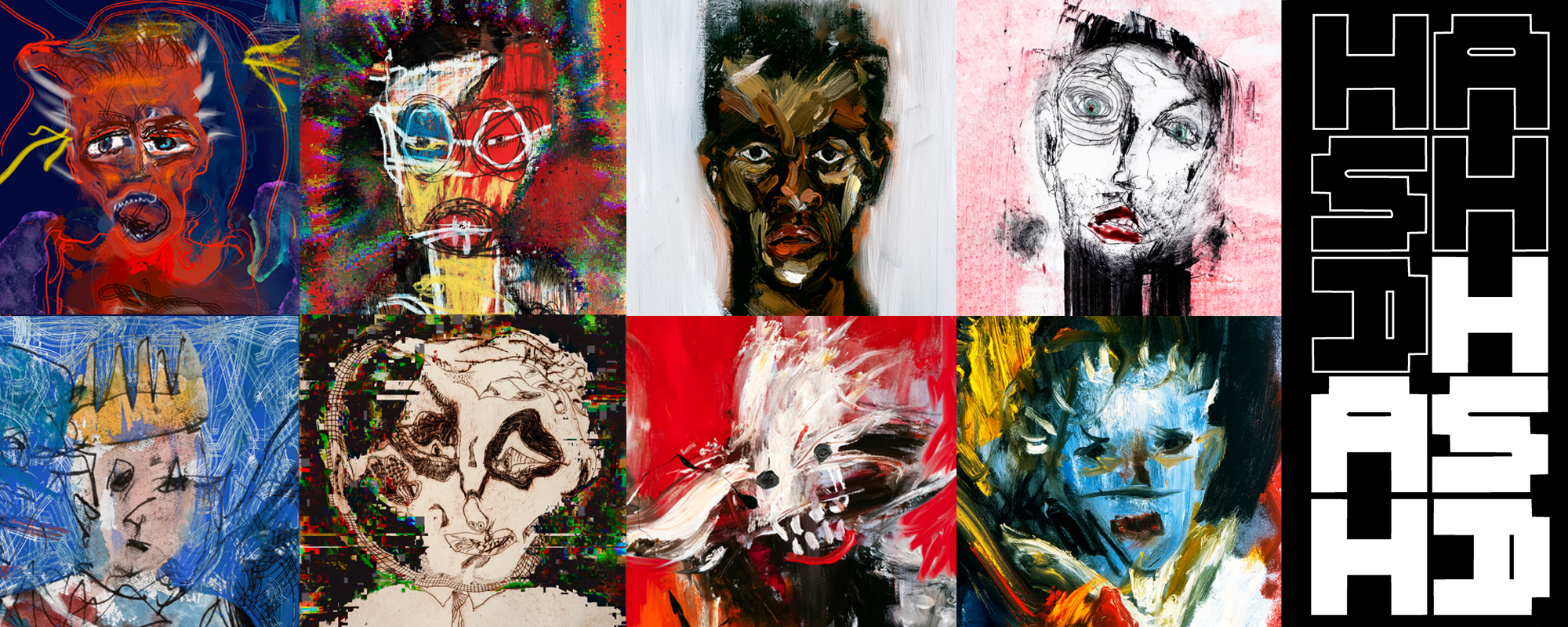
Michael Hafftka has been painting for over fifty years. His work hangs in the permanent collections of the Metropolitan Museum of Art, the Museum of Modern Art, SFMOMA, the Carnegie Museum of Art, and the British Museum. He has worked from the same Brooklyn studio for decades, building a body of figurative expressionist painting that confronts the interior life head-on, grief, desire, violence, tenderness, without flinching.
In 2021, at 68, he entered web3. Not as a latecomer chasing a trend, but as a painter who had first experimented with digital tools in 1996, set them aside when the technology wasn't ready, and returned when he saw that the infrastructure had finally caught up with the ambition. Since then, he has become one of the most prolific and respected traditional artists working on-chain.
Faces is his latest collection, 99 unique 1/1 works that draw from five decades of practice, from analog paintings of the 1970s to digital and animated pieces completed in 2025. Each token is paired with a hand-signed, museum-quality print. The collection sold out in under a minute.
We sat down with Hafftka to talk about the work, the collection, and what fifty years of painting teaches you about a medium that didn't exist when you started.
The Interview
Faces draws from fifty years of practice, from analog paintings of the 1970s to digital and animated works completed in 2025. What made now the right moment to bring these works together as a single collection?
In your statement for Faces, you wrote that you're not interested in likeness or realism for its own sake, that you're after "a portrait of humankind." When you sit down to begin a face, what are you actually looking for, and how do you know when you've found it?
You first started making digital work in 1996, but said the tools and connectivity at the time were so primitive that you set it aside. You came back to it in 2021. Most painters of your generation, particularly those with work in major museum collections, haven't made that leap. What drew you back in, and what did you see in the medium that others might have missed?
Beyond the tools, the on-chain part is its own shift. Provenance, ownership history, the certificate of authenticity all live in code rather than in galleries and archives. Coming from a tradition where provenance is built by museums, dealers, and decades of paper trail, does on-chain feel like a logical extension of the practice, or something genuinely new?
Faces lives on chain as 99 unique 1/1s, with each having a corresponding hand-signed museum-quality print. How do you think about the relationship between the digital work and the physical object? Are they two versions of the same thing, or two different works?
Since the release, you've been posting lore videos on X telling the story behind each Face. Each piece carries real stories, emotions, and moments from your life. What made you want to share that layer of the work publicly, and has the act of narrating it shifted how you see the pieces yourself?
The story of how your work first reached MoMA in the 1980s, an uptown gallery keeping your etchings on file, Dr. Isaac Schenkein discovering them, you only later learning he was an Auschwitz survivor, has a quality of chance to it. Now your work is being collected by people who found you on OpenSea. What do you make of how the path to recognition has changed?
Working from the same Brooklyn studio for decades, what's it like to watch the digital art scene form online while you've been painting in the same room the whole time?
Faces sold out in under a minute. What does an artist with fifty years of work behind them want from the people who've now collected this collection?
Thank you to Michael for taking the time to chat with us.