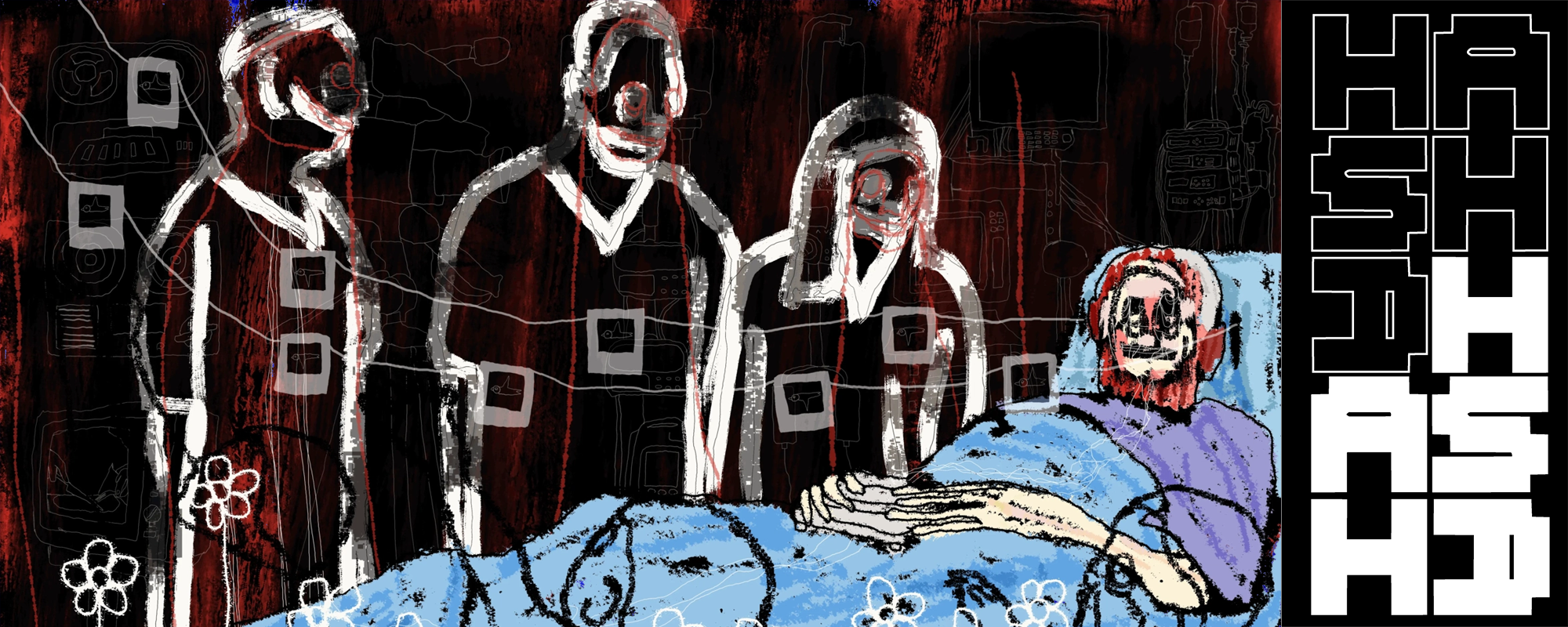
we'd see each other more, some day, after it was all over...
Seventy five
Start with the number, because the number is the piece.
dying is not enough is seventy five one of one animations by the Indiana artist diewiththemostlikes, his third project with glitch marfa, sold across thirty three hours in mid July with no reserve, every lot opening at zero. Ask why seventy five and you get the collection's whole argument in one fact: seventy five is the average age of death in Indiana. Derek Edwards of glitch put it to him directly in the interview they filmed together in Los Angeles. Yep, Die said. That's right.
The lot count is a memento mori. Every work sold is a year of the life a person in his state can statistically expect, and when the last one hammered, the collection had lived exactly one average Indiana lifetime. Nobody at the auction needed to know that for the sale to function. It sits underneath anyway, the way the best conceptual moves do, working on you before you have heard the explanation.
The marionette
Die's own description of the work is more precise and much darker than any curatorial gloss. The collection, he says in the interview, is an observation of a descent into a husk, a marionette perpetually resurrected and slaughtered by an AI, pulled back from what would have been a peaceful death and forced to perform, the song and dance in the mascot outfit, a continual reheat of a former version of ourselves.

That is why dying is not enough. Not because death lacks finality in some spiritual sense, but because the machine no longer permits it. The content churn does not let a version of you rest. It reanimates, reposts, remixes, and demands the performance again tomorrow. One of the lots is titled conversations resurrected and slaughtered and fed in small cups to open mouths. Another shows a rat king crowned on the evening news. The titles read like a poet's notebook because they are one; Die writes poems every morning, and each work in the collection is accompanied by them, some pure timeline madness, some, in his words, deeply human and in a state of grief.
He tells one story in the interview that could stand for the whole project. He posts work about all of this, and the thoughtful compliments that come back are from AI bots. Wow, this is a deep piece. You start, he says, to not really be able to determine what is real or not, or if you are already dead and being interacted with by all these other deceased machines.
Dying is not enough, because the machine will not let you stay dead.
Nothing is enough
Then he adds the comma the title has been hiding. The collection is called dying is not enough, he says, but really there could be a comma in saying that living is not enough either. The line between the two is being obscured massively, all the time. Asked what would be enough, he does not reach for consolation: nothing is enough. That is what the world now demands of us, a constant state of inadequacy. Unable to fulfil either of the two basic states of life, we sit in a purgatory, a paralysis.
glitch's curatorial text arrives at the same place from an older direction: the human as the only creature that knows it is finite and is obliged to live with the knowledge, burying it in the routines of work and consumption, memento mori pointing at nothing beyond itself, no consolations offered. The collector funghibull, writing after the sale, compressed the two readings into one line, dying is not enough, living is not enough, and what might be enough is dying empty, having made the work, together, while knowing nothing ever will be.
By hand
Here is the tension that makes the work honest instead of merely bleak. The man who made a collection about being puppeted by the machine keeps the machine entirely out of his practice. AI is totally absent from my process, he says, half laughing that he barely knows how to use it. The animations are done by hand, frame by frame, every onion skin its own piece. He calls the learning miserable, the loops that will not close, the frames that come out choppy, and means it as the recommendation: there is so much you can find out about yourself doing the hardest shit imaginable.
The dailiness borders on monastic. A bowl of dry Grape Nuts, poems in the morning, a digital piece, then four or five hours of physical painting, sometimes to a single sixty three minute doom metal track on repeat. There are around fifty paintings hanging from hooks in a hallway of his house and seventy or eighty watercolours behind them. He describes himself as a documentarian and the work as a journal, a way to expel the feelings into a permanent state, on a page or a canvas, instead of letting them cycle in his head. It really helps me be a happier person, he says, which is the answer to the question everyone asks about why such a happy man makes work about death.
And he has one rule for himself that lands like a thesis once you hear the concept: the next piece always has to escalate, you don't see reheated things. The reheat, the endless warming over of a former self, is exactly what the machine does to us. His refusal of it in the studio is the same refusal the collection stages at scale.
The room it was made for
The week the collection sold, Derek Edwards lost someone, a second mother to him, the closest person to him that has ever passed. She was seventy five years old. He says it in the interview, quietly, tying the number back to itself, and talks about the regret that arrives with a death like that, whether there could have been more time, whether the machine of work and screens was eating the hours that mattered. The collection he had spent months helping to bring into the world turned out to be equipment for the exact grief he was standing in.
That is also why it came out through glitch. This is a really personal project, Die says, so we had to be really specific about who we wanted to help us bring it into the world, and he credits the gallery for thinking deeply about the pieces, the writing, the titles, everything that goes into it. glitch has run this way from the start, an analog gallery for internet objects in Judd's town in West Texas, presenting work with no reserve because the house has never held an opinion about price. Zero is just the open question, asked seventy five times.

The market answered all seventy five. Every lot sold, to forty seven collectors, 403.53 ETH across the auction, with the title work, a 1/1 carrying the collection's name, going alongside for 50 ETH to Raoul Pal and Blondie on behalf of Something Bigger after what Pal called a huge bidding battle. But the result is the least of it, and Die's closing in the interview is the part worth keeping. There is a part of me in every piece, he says. He wants people to know they were made with love and with obsession, and to see themselves in the reflection, to bring whatever they are carrying, celebration or mourning, and have it belong to the piece too.
The interview ends with the two of them saying vaya con dios, and then, because the whole thing is a Die piece whether he admits it or not, Phil Collins starts to play.
Nothing is enough. Seventy five answers came back anyway.

— the poem that accompanies the title work —
we'd see each other more some day after it was all over after the last drops had been absorbed by the veins that functioned as our mouths after the quilts were removed and the windows were opened so that the parts of us left in that room could be free some day we'd look at the fence in the neglected yard and wonder why the plastic bags caught in its links held more air than we ever did
The title work — a 1/1 carrying the collection's name — was acquired by @Blondie23LMD × @RaoulGMI on behalf of Something Bigger for 50 ETH.
What outlasts the sale is the loop. Seventy five of them, still running on screens that were never going to let them rest, the argument made and then proven in the same motion. Die built something the machine cannot kill, kept the machine out of the making of it, and did the work by hand anyway, frame by frame, because that was the only honest way to say any of it. The number was always a lifetime. Now it belongs to forty seven people, and to whatever each of them was carrying the day they bid. On a long enough timeline, that may be the only part that was ever the point.
— watch the full interview —